
External Affairs Minister S Jaishankar visited Kyiv, reiterating India's readiness to assist in ending the Ukraine-Russia war. He emphasised that solutions would not emerge from the battlefield and highlighted Prime Minister Modi's call for an end to the conflict. Discussions also covered humanitarian aid, the impact on commercial shipping, and bilateral trade, with Jaishankar inviting his Ukrainian counterpart to India for further talks.

External Affairs Minister S Jaishankar stated that India is in continuous dialogue with both Ukraine and Russia, seeking ideas and suggestions to mitigate or cease the ongoing conflict. Following his visit to Kyiv, Jaishankar reiterated India's stance that the war must end through dialogue and diplomacy, emphasising that trade decisions like oil purchases are not the solution to the conflict.

US Secretary of State Marco Rubio, during his visit to Mumbai, affirmed that the US policy on weapons aid and intelligence sharing for Ukraine remains unchanged. He stated that President Donald Trump is "frustrated and angry" over false accusations of deliberately harming Ukraine and is keen on a negotiated end to the conflict. Rubio also addressed concerns about missile interceptor supplies and intelligence sharing regarding recent air strikes, attributing any issues to technical matters rather than deliberate denial. He highlighted global concerns over fuel shortages and the risk of escalation, stressing the urgent need to end the war.

Ahead of President Vladimir Putin's visit to India for the BRICS summit, Russia has expressed support for New Delhi's peace initiatives to resolve the Ukraine conflict. Discussions between Putin and PM Modi will cover defence, energy, technology, and the repatriation of Indian nationals from the Russian military, alongside addressing trade and investment ties.

External Affairs Minister S Jaishankar on Friday defended Prime Minister Narendra Modi's hugging of Russian President Vladimir Putin, a gesture that had drawn much criticism from the West.
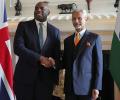
India's External Affairs Minister S Jaishankar has stated that the US administration under President Donald Trump is moving towards multipolarity, which aligns with India's interests. He also revealed that India and the US have reached an agreement on the need for a bilateral trade pact. Jaishankar touched upon various foreign policy issues including India's role in the Russia-Ukraine conflict, the trajectory of the BRICS grouping, and relations with China during a session at the Chatham House think-tank in London.
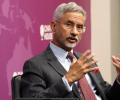
"From President Trump's perspective, the one big shared enterprise that we have is the Quad, which is an understanding where everybody pays their fair share. There are no free riders involved. So that's a good model which works," he said. The Quad alliance consists of the US, India, Australia and Japan.
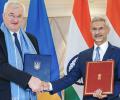
External Affairs Minister S Jaishankar reiterated India's support for an early end to the conflict in Ukraine after a conversation with his Ukrainian counterpart, Andrii Sybiha. The discussion follows recent diplomatic engagements, including meetings between Prime Minister Modi and both President Putin and President Zelenskyy.
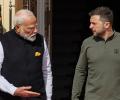
Prime Minister Narendra Modi on Friday invited President Volodymyr Zelenskyy to visit India and the Ukrainian leader said he would be happy to travel to the 'great' country.
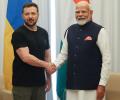
The proposed visit is being planned around the Ukrainian National Day of August 24 and the prime minister may also travel to Poland as part of a two-nation tour, they said.

With these propositions in mind, India started "some exploratory discussions" he said, adding that it started during Prime Minister Narendra Modi's visit to Italy during G-7, and then during his visit to Moscow.

India welcomes the summit talks between US President Donald Trump and his Russian counterpart, Vladimir Putin, in Alaska and hopes for an early end to the conflict in Ukraine.
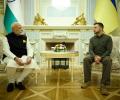
Ukraine and Russia need to engage with each other to find a solution to the ongoing conflict between them, India said on Friday after Prime Minister Narendra Modi held wide-ranging talks with President Volodymyr Zelenskyy in Kyiv under the shadow of the raging war.

'...it should not delude itself into thinking that India's security or its great-power ambitions will be advanced by those partnerships.'
'Instead, what India should focus on is on riding out the next three-and-a-half years of Trump's presidency with minimal damage to itself.'

India is a great power that determines its national interests and chooses its partners, Russian Foreign Minister Sergey Lavrov has said, describing as "completely unjustified" the "enormous pressure" on New Delhi due to its energy cooperation with Moscow.
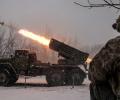
A peace keeping role for India is a distinct possibility. Indian military has both the numbers and experience to carry out this job, observes Colonel Anil A Athale (Retd).

The war and Modi's recent visit to Ukraine is expected to figure prominently in the bilateral meeting, according to US National Security Adviser Jake Sullivan.
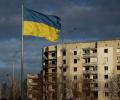
Only the future will tell if Modi can leave his mark on the Ukraine crisis. Nonetheless, it is both a challenge and an opportunity for India's diplomacy, notes Rup Narayan Das.
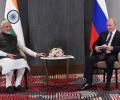
The phone conversation came days after it emerged that Modi will not be travelling to Russia for the annual India-Russia summit this year.

"We share important interests with India. We share important values with India. And we know India has a relationship with Russia that is distinct from the relationship that we have with Russia. Of course, that is okay," Price told reporters at his daily news conference on Friday.

'Frankly, India has no role to play.' 'This is a showdown between the US and NATO on one hand and Russia on the other.' 'That said, the outcome of this titanic struggle in Central Europe will remould the world order and affect India profoundly,' argues Ambassador M K Bhadrakumar.
